Best Rice Cookers in India: Sizes, Ceramic Bowls and Whether You Even Need One
Let’s deal with the obvious objection first: most Indian kitchens already cook rice perfectly well in a pressure cooker, and if that’s working for you, a rice cooker isn’t going to change your life. I’d rather say that upfront than sell you something you don’t need.
Where a rice cooker genuinely earns its place is anywhere the cook isn’t standing in the kitchen. Hostel rooms, bachelor flats, working couples, PG accommodation, elderly parents living alone. You put in rice and water, press one switch, walk away, and it turns itself down to keep-warm when it’s done. No whistles to count, nothing to burn, nothing to watch. It also steams idli, dhokla and vegetables while the rice cooks below, which quietly makes it a two-dish appliance.
Below are five that cover the range from a one-litre hostel cooker to a full multi-cooker, plus the one spec that separates the ones that last from the ones that don’t.
Do you actually need a rice cooker, or just a better pressure cooker?
Five things to get right. The inner bowl is the most important one.
- The inner bowl decides how long the cooker lasts. This is the single biggest source of complaints in this category. Cheap non-stick coatings scratch and peel within a year or two, especially if anyone in the house uses a steel spoon. Ceramic-coated bowls, like the AGARO models here, hold up considerably better and are worth the price difference. Plain aluminium pots don’t peel at all but stick more.
- Size by people, and don’t oversize. Cooker capacity is measured with the pot full, so buy with a little headroom but not a lot. Roughly: 1 litre for one or two people, 1.8 litres for three to four, 3 litres for a family of five, 5 litres if you regularly cook for guests. An oversized cooker cooks small quantities badly.
- Check what comes in the box for steaming. A steamer plate turns the cooker into an idli, dhokla and vegetable steamer, which roughly doubles what you use it for. Some models include one, some don’t. It’s a small part that makes a big difference.
- Basic cookers have one switch. That’s a feature, not a limitation. The traditional design cooks until the water’s gone and then drops to keep-warm automatically. It’s mechanically simple, cheap to repair anywhere, and there’s very little to fail. Preset timers and LED panels are genuinely nice, but they’re also more electronics to go wrong.
- Expect a little starch water to spit, and plan for it. Almost every basic rice cooker bubbles a bit of starchy water out of the vent, especially with unrinsed rice. Rinse the rice properly, don’t overfill, and keep it away from the wall and the switchboard. Models with a steam vent lid manage it better.
The best electric rice cookers you can buy right now
AGARO Regal 3L Ceramic – the one that’ll still be good in five years
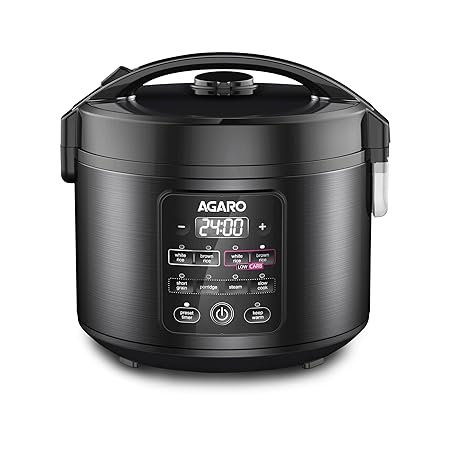
The ceramic inner bowl is the reason to buy this. Non-stick coatings on cheaper cookers scratch and peel – it’s the most common complaint in the whole category – and ceramic simply holds up better against daily use and the occasional steel spoon. Over five years that’s the difference between one cooker and three.
The preset timer is more useful than it sounds: set it in the morning and come home to hot rice, which is exactly the problem a rice cooker exists to solve for working households. It’s the best-received cooker here, it includes a stainless steel steamer for idli and vegetables, and 3 litres is the right size for most Indian families.
Best for: A family of four to five who want a rice cooker that won’t need replacing in two years.
- 👍 Ceramic inner bowl lasts far longer than typical non-stick coatings
- 👍 Preset timer means hot rice waiting when you get home
- 👍 Includes a stainless steel steamer for idli, dhokla and vegetables
- 👍 Best owner reception of the dedicated rice cookers here
- 👍 3 litres suits a family of four to five properly
- 👎 Most expensive dedicated rice cooker in this roundup
- 👎 LED panel and electronics are more to go wrong than a one-switch design
- 👎 Bulkier on the counter than the 1 to 1.8 litre models
- 👎 Overkill if you’re cooking for one or two
Pigeon Joy 1.8L – the default Indian rice cooker
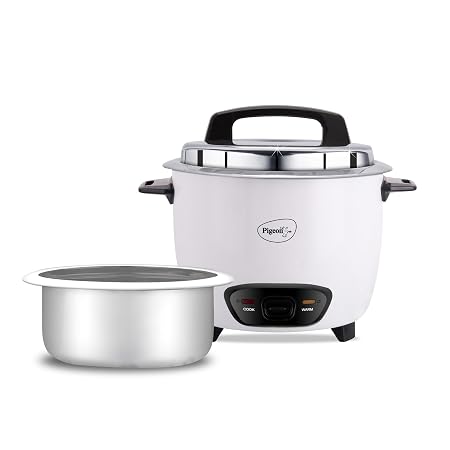
This is the rice cooker most Indian homes actually buy. Pigeon is a Stovekraft brand with a service and spares presence across the country, the design has barely changed in years because it doesn’t need to, and 1.8 litres is the right capacity for three or four people.
One switch, keep-warm when it’s done, a double pot for cooking dal alongside rice. There’s nothing clever about it and that’s precisely the appeal – almost nothing can fail, and if something does, any local repair shop can handle it. The non-stick coating is the weak point, so use a wooden or plastic spoon and it’ll last much longer.
Best for: A small family or a couple who want something simple, cheap and repairable anywhere.
- 👍 Cheap, simple and repairable at any local appliance shop
- 👍 1.8 litres suits a couple or small family well
- 👍 Double pot lets you cook dal alongside the rice
- 👍 Pigeon spares and service are available across India
- 👍 Very large body of Indian owner feedback
- 👎 Non-stick coating scratches and wears with steel utensils
- 👎 No timer, no display, no keep-warm control – just one switch
- 👎 Starch water spitting from the vent is a common complaint
- 👎 Build feels basic next to the AGARO models
AGARO Regency 5L Ceramic – for large families and frequent guests
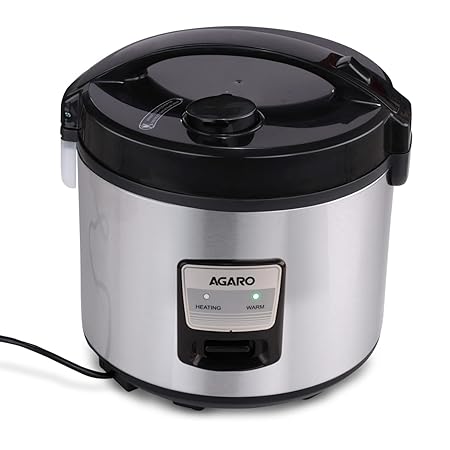
5 litres is a lot of rice – comfortably enough for a joint family or for the kind of household where people turn up unannounced and stay for lunch. It keeps the ceramic-coated bowl from the Regal, so durability is far better than a cheap non-stick pot, and the keep-warm function holds a full batch hot for hours.
The trade-off is that it drops the preset timer and LED display for a simpler mechanism, which honestly means less to break. It’s also poor at small quantities – if you’re regularly cooking one or two cups of rice, this is the wrong size and it’ll cook them unevenly.
Best for: Joint families, homes that regularly feed guests, or anyone cooking rice in bulk.
- 👍 5 litre capacity handles joint families and guests easily
- 👍 Ceramic coated bowl is far more durable than plain non-stick
- 👍 Keep-warm holds a large batch hot for hours
- 👍 Simpler mechanism than the Regal, so less to fail
- 👍 Cheaper than the smaller Regal despite the larger capacity
- 👎 Cooks small quantities unevenly – wrong choice for one or two people
- 👎 No preset timer or display
- 👎 Takes up serious counter space
- 👎 Smaller base of owner feedback than the Regal or Pigeon models
Pigeon Joy 1L Single Pot – the hostel and bachelor pick
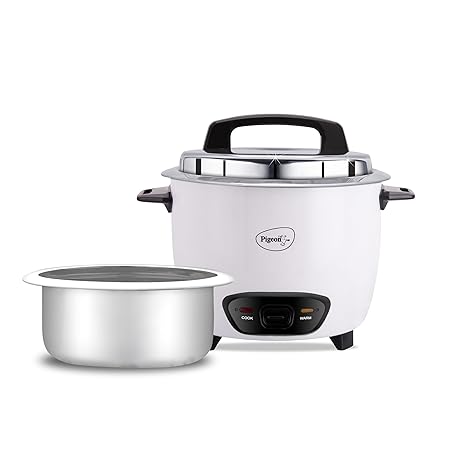
For one or two people this is all the rice cooker you need, and it’s the cheapest thing in this roundup. It’s small enough to live on a hostel desk or a tiny PG counter, light enough to carry when you move, and simple enough that there’s essentially nothing to break.
It’s more versatile than it looks too – people use these to boil eggs, steam vegetables, make maggi and cook khichdi, which for a student or someone in a room without a proper kitchen is close to a complete cooking setup. Just don’t expect it to feed more than two.
Best for: Hostel rooms, PG accommodation, one-person flats and travel.
- 👍 Cheapest cooker in this roundup
- 👍 Small and light enough for a hostel room, PG or frequent moves
- 👍 Doubles for boiling eggs, steaming vegetables and making khichdi
- 👍 Almost nothing on it can fail
- 👍 Strong owner feedback for a product this cheap
- 👎 1 litre feeds one or two people at most
- 👎 Single pot, so no cooking dal alongside the rice
- 👎 Non-stick coating is basic and wears quickly
- 👎 No keep-warm sophistication – it’s as simple as cookers get
Nutricook Smart Pot 2 (5.7L) – not really a rice cooker, and that’s the point
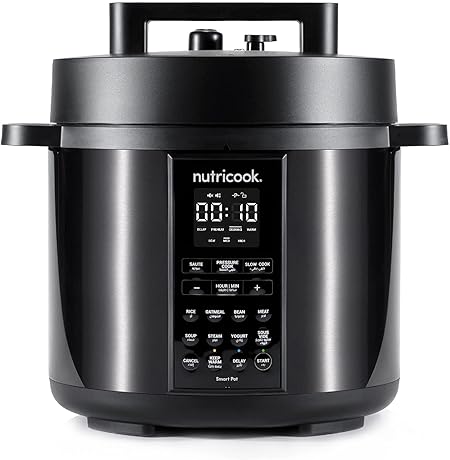
This is a 9-in-1 electric pressure cooker that happens to cook rice very well, and if you’re shopping for a rice cooker it deserves consideration purely on the maths. It pressure cooks, slow cooks, steams, sautes and does rice – which for a lot of Indian kitchens means one appliance instead of a rice cooker plus a separate electric pressure cooker.
The stainless steel inner pot is the real durability advantage: nothing to peel, nothing to scratch, and you can scrub it. It’s easily the best-received product in this roundup. The catch is that it costs several times what a basic rice cooker does, and if all you want is rice, that’s money spent on functions you may never touch.
Best for: Anyone who’d rather buy one appliance that replaces three.
- 👍 Stainless steel inner pot – nothing to peel or scratch, ever
- 👍 Replaces a rice cooker, an electric pressure cooker and a slow cooker
- 👍 Best owner reception of anything in this roundup
- 👍 Pressure cooking cuts dal and rajma cooking time substantially
- 👍 Two-year warranty, which is unusual in this category
- 👎 Costs several times what a basic rice cooker does
- 👎 Considerably more complex – a learning curve and more to go wrong
- 👎 Large footprint on the counter
- 👎 Overkill if you genuinely only want to cook rice
Frequently Asked Questions
Is a rice cooker better than a pressure cooker for rice?
Not better, but easier. A pressure cooker is faster; a rice cooker is hands-off – no whistles to count, and it drops to keep-warm on its own. It’s most useful in hostels, PGs, bachelor flats and working households where nobody’s standing in the kitchen.
What size rice cooker do I need?
Roughly 1 litre for one or two people, 1.8 litres for three to four, 3 litres for a family of five, and 5 litres if you regularly cook for guests. Don’t oversize – a large cooker handles small quantities poorly.
Is a ceramic inner bowl worth paying more for?
Yes. Peeling non-stick coating is the single most common complaint about rice cookers in India. The ceramic bowls on the AGARO Regal and AGARO Regency last considerably longer, and stainless steel on the Nutricook doesn’t degrade at all.
Can I steam idli in a rice cooker?
Yes, if it comes with a steamer plate – the AGARO Regal includes a stainless steel one. You can steam idli, dhokla and vegetables above while rice cooks below, which roughly doubles what the appliance is good for.
Why does starchy water spit out of my rice cooker?
It happens with most basic cookers, especially with unrinsed rice or an overfilled pot. Rinse the rice properly, stay under the maximum line, and keep the cooker away from the wall and the switchboard.
Which rice cooker is best for a hostel or PG room?
The Pigeon Joy 1L Single Pot. It’s the cheapest here, small enough for a desk, and people routinely use it for eggs, maggi, khichdi and steamed vegetables as well as rice.
The bottom line
For most families, the AGARO Regal 3L is the one worth paying for – the ceramic bowl means it’s still good in five years, and the preset timer solves the actual problem of coming home to cook. If you want cheap and repairable, the Pigeon Joy 1.8L is what most Indian homes already run, and the Pigeon Joy 1L is the obvious hostel pick. Large families should look at the AGARO Regency 5L. And if you’d rather buy one appliance that does the work of three, the Nutricook Smart Pot 2 is genuinely the best product here – just not the cheapest way to cook rice.
As an Amazon Associate we earn from qualifying purchases — at no extra cost to you. We don’t print prices or ratings here because they change daily; tap through to Amazon for the current price and latest reviews.