Best Prestige Induction Cooktops in India: PIC 20 to the IRIS ECO
Prestige is the brand most Indian kitchens already trust for pressure cookers, and its induction cooktops carry the same reputation – simple, durable, and backed by one of the widest service and spares networks in the country. If your induction cooktop breaks, getting it looked at is rarely the problem; that’s not true of every brand in this category.
The current Prestige range is confusingly similar across models on paper – most sit around 1600-2000 watts with Indian menu presets and surge protection – so the real differences come down to specific features like automatic voltage regulation and price. I’ve covered the four models actually worth considering, all genuine Prestige units rather than similarly-named competitors.
Why Prestige specifically, and what actually matters on the spec sheet
Four things worth knowing before picking a Prestige model.
- Surge protection matters more in India than the spec sheet suggests. Voltage spikes from grid instability are common in a lot of the country, and induction cooktops are more sensitive to them than a simple gas stove. The 4KV surge protection on Prestige’s PIC line is a genuine safeguard against a spike frying the internal electronics, not marketing filler.
- Indian menu presets are a real convenience, not a gimmick. Preset programs tuned for roti, idli, curry and other common Indian dishes take the guesswork out of power and time settings for standard cooking – genuinely useful if you’re new to induction cooking and unsure what setting suits what dish.
- Automatic voltage regulation is worth seeking out if your area has unstable supply. Some Prestige models specifically include this to compensate for fluctuating input voltage, protecting the cooktop and keeping cooking temperature more consistent. Check for it explicitly if your electricity supply is known to be inconsistent.
- Wattage differences between 1600W and 2000W matter for speed, not much else. A 2000W unit boils and heats faster and copes better with larger vessels, but 1600W handles normal Indian cooking – rotis, curries, tea – perfectly well. Don’t pay extra for wattage you won’t notice using in daily cooking.
The best Prestige induction cooktops you can buy right now
Prestige PIC 20 – the most-owned Prestige cooktop, and the safe default
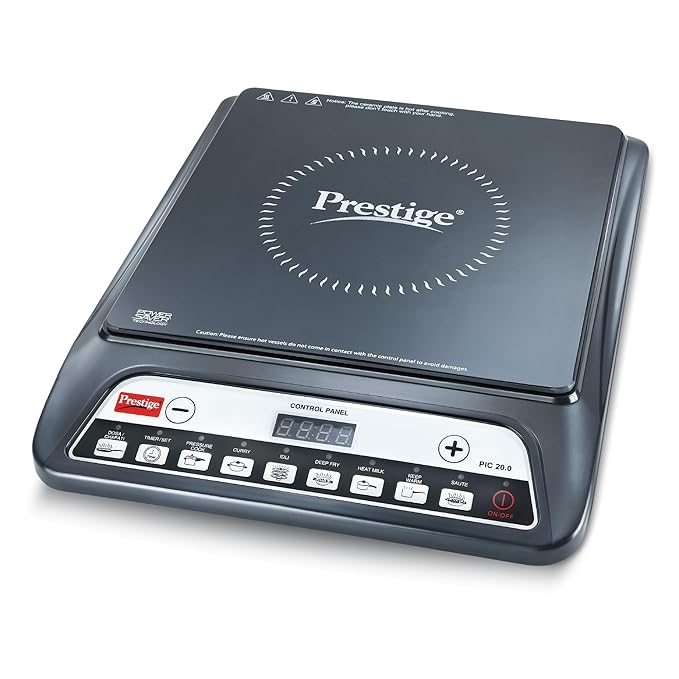
This has an enormous base of Indian owner feedback – the largest of any cooktop in this roundup by a significant margin – built up over years on sale. That kind of sustained volume is the clearest quality signal available in this category, and it reflects a genuinely dependable everyday cooktop.
1600W handles normal Indian cooking comfortably, the 8 preset Indian menu options take the guesswork out of common dishes, and the 4KV surge protection guards against the voltage spikes that damage cheaper cooktops. Soft touch buttons and easy-clean surfacing round out a well-thought-through everyday appliance.
Best for: Most households. The best-proven Prestige induction cooktop by a wide margin.
- 👍 Largest base of Indian owner feedback of any cooktop in this roundup
- 👍 4KV surge protection genuinely guards against voltage spikes
- 👍 8 preset Indian menu options simplify everyday cooking
- 👍 1600W is enough for normal household cooking
- 👍 Widely available Prestige spares and service
- 👎 No automatic voltage regulation, unlike the IRIS ECO
- 👎 Portable, single-burner format like all cooktops here
- 👎 Basic display, no advanced timer programming
- 👎 1600W is slower than 2000W models for large-volume boiling
Prestige PIC 16.0 Plus – the higher-wattage option
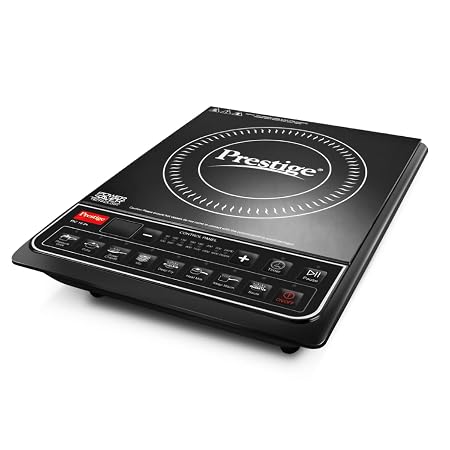
This steps up to 2000W from the standard PIC 20’s 1600W, which translates to noticeably faster boiling and better handling of larger vessels – genuinely useful if you’re cooking for a large family or batch-cooking regularly. It carries an enormous base of owner feedback in its own right, second only to the standard PIC 20 in this roundup.
Everything else follows the same reliable Prestige template – 4KV surge protection, Indian menu presets with timer, soft touch controls. If you specifically want faster cooking rather than the exact same speed as the entry model, this is the sensible step up.
Best for: Households that cook in larger quantities or want faster boiling and heating.
- 👍 2000W handles larger volumes and boils noticeably faster than 1600W models
- 👍 Very large base of owner feedback
- 👍 Same 4KV surge protection and Indian menu presets as the PIC 20
- 👍 Good for larger families or frequent batch cooking
- 👍 Same widely available Prestige service network
- 👎 Costs more than the standard PIC 20 for the wattage upgrade
- 👎 Extra speed isn’t necessary for typical small-household cooking
- 👎 No automatic voltage regulation
- 👎 Similar overall feature set to the cheaper PIC 20 aside from wattage
Prestige PIC 20 Neo – the current-generation update with automatic voltage regulation
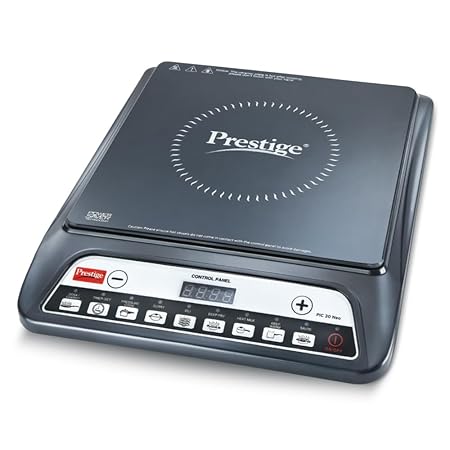
This is the newer-generation update to the PIC 20 template, and the standout addition is automatic voltage regulation – a genuine advantage if your area’s electricity supply fluctuates, since it compensates for that instability rather than just protecting against surges after the fact.
It carries a strong owner rating despite being newer to market than the established PIC 20, reflecting a well-received update. If unstable voltage is a known issue where you live, this is the Prestige model built specifically to address it, at a similar price to the standard PIC 20.
Best for: Buyers in areas with unstable electricity supply who want that specifically addressed.
- 👍 Automatic voltage regulation compensates for unstable supply, not just spike protection
- 👍 Strong owner ratings for a newer-generation model
- 👍 Same 1600W and Indian menu presets as the proven PIC 20
- 👍 Timer with user preset for flexible cooking
- 👍 Similar price to the standard PIC 20 despite the added feature
- 👎 Smaller accumulated owner feedback base than the long-established PIC 20
- 👎 Voltage regulation matters most if your area specifically has unstable supply
- 👎 Manual mode operation adds a small learning step for new users
- 👎 Newer to market, so less long-term reliability data than the PIC 20
Prestige IRIS ECO – the power-saving option
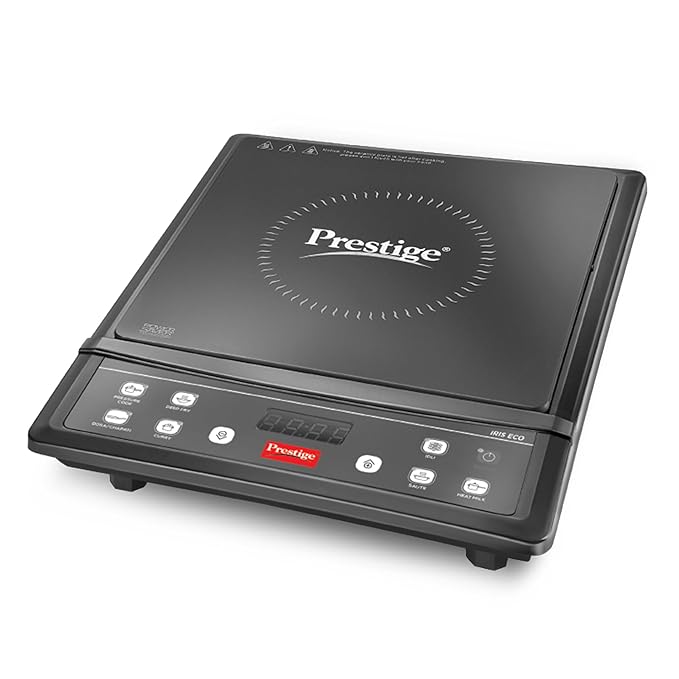
At 1200W, this is the lowest-wattage cooktop in Prestige’s current lineup, aimed specifically at households that want lower running power consumption rather than the fastest possible cooking. It combines this with automatic voltage regulation, the same stabilising feature found on the PIC 20 Neo, for households with less stable electricity supply.
It’s a genuinely large base of owner feedback for a lower-wattage specialist model. For a single person, a couple, or a household mainly making tea, simple curries and rotis rather than large-batch cooking, the lower wattage is a sensible trade for lower power bills rather than a real limitation.
Best for: Smaller households, or anyone prioritising lower power consumption over faster cooking.
- 👍 Lower 1200W consumption genuinely reduces running power cost
- 👍 Automatic voltage regulation included
- 👍 Power Saver mode specifically targets efficiency
- 👍 Large accumulated base of owner feedback
- 👍 Good fit for smaller households and lighter cooking
- 👎 1200W is noticeably slower than the 1600W and 2000W options here for larger volumes
- 👎 Not well suited to large-batch or large-family cooking
- 👎 Fewer Indian menu presets highlighted than the standard PIC line
- 👎 Lower wattage limits use with very large vessels
Frequently Asked Questions
Which Prestige induction cooktop should most people buy?
The Prestige PIC 20. It has by far the largest base of Indian owner feedback of any cooktop in this roundup, with 4KV surge protection and Indian menu presets covering everyday cooking well.
Does 2000W cook noticeably faster than 1600W?
Yes, for boiling and larger vessels. The Prestige PIC 16.0 Plus at 2000W is noticeably quicker than the 1600W PIC 20, though 1600W handles typical Indian household cooking – rotis, curries, tea – perfectly well.
What does 4KV surge protection actually protect against?
Voltage spikes from unstable electricity grids, which are common in parts of India and can damage an induction cooktop’s internal electronics. It’s a genuine safeguard on the standard Prestige PIC line, not just a marketing spec.
What’s the difference between surge protection and automatic voltage regulation?
Surge protection guards against sudden spikes. Automatic voltage regulation, found on the PIC 20 Neo and IRIS ECO, actively compensates for ongoing voltage fluctuation, which matters more if your area’s supply is consistently unstable rather than just occasionally spiking.
Is a lower-wattage cooktop like the IRIS ECO worth it?
If you’re a smaller household mainly cooking simple meals and want lower running power costs, yes. The IRIS ECO‘s 1200W is genuinely more efficient, though it’s noticeably slower than the 1600W or 2000W options for larger-batch cooking.
Are Indian menu presets on induction cooktops actually useful?
Yes, particularly if you’re new to induction cooking. They take the guesswork out of power and time settings for common dishes like roti, idli and curry, which is otherwise a real learning curve moving from a gas stove.
The bottom line
For most households, the Prestige PIC 20 is the safest buy – the largest owner base of any cooktop here, proven surge protection, and sensible everyday wattage. If you cook in larger volumes or want faster boiling, the PIC 16.0 Plus at 2000W is worth the step up. If your electricity supply is genuinely unstable, the PIC 20 Neo adds automatic voltage regulation at a similar price. And for a smaller household prioritising lower running costs, the IRIS ECO trades some speed for real power savings.
As an Amazon Associate we earn from qualifying purchases — at no extra cost to you. We don’t print prices or ratings here because they change daily; tap through to Amazon for the current price and latest reviews.