Best Fans in India (2026): Ceiling, Table & Rechargeable Picks for Every Room
Every Indian summer runs on the same three appliances — the fridge, the AC if you have one, and whatever’s spinning over your head. But “buy a fan” is a deceptively broad instruction. Do you mean a ceiling fan for the bedroom, a table fan for the study corner, or one of those rechargeable ones your building’s watchman swears by during load-shedding?
I dug through what people are actually buying across all three categories this year, because honestly, most “best fan” lists only cover ceiling fans and ignore that half of India also needs a backup plan for power cuts. This roundup covers a proper ceiling fan, a quiet BLDC table fan, and two rechargeable options — one you’d keep on a desk during an outage, one you’d literally carry in a handbag.
None of these are the fanciest thing on Amazon. They’re the models that keep showing up in search because real buyers keep buying them. Here’s how to pick the right one for your room, your electricity bill, and your patience for assembling things.
How to pick the right fan (ceiling, table or rechargeable)
Five things to check before you add to cart — takes two minutes, saves you a return request.
- BEE star rating actually matters here. A 5-star BLDC ceiling fan can use less than half the electricity of an old 1-star induction-motor fan running the same speed, all day, every summer. Over a few years that difference is real money, not marketing.
- Air delivery (CMM) beats blade size for judging power. Two fans can have the same sweep and wildly different airflow. If the listing mentions CMM (cubic metres per minute) or RPM, higher is stronger — don’t just eyeball blade width.
- If you get power cuts, buy the backup separately. A rechargeable table or personal fan with a few hours of battery backup is a completely different purchase from your main ceiling fan — don’t expect one product to do both jobs well.
- Rust resistance matters more in coastal and hard-water areas. Ceiling fans live in bathrooms-adjacent humidity for a decade; galvanised or rust-resistant blades genuinely last longer than plain painted ones.
- Noise level matters for bedrooms. BLDC motors run noticeably quieter than old-style induction motors at the same speed — worth the extra rupees if the fan’s going over your bed.
- Ceiling fan installation needs an electrician, budget for it. Unlike a table or rechargeable fan, a ceiling fan isn’t a plug-and-play purchase — factor in a small installation cost unless you’re swapping a like-for-like replacement yourself.
The best fans you can buy right now
Orient Electric Apex-FX 1200mm — the straightforward ceiling fan pick
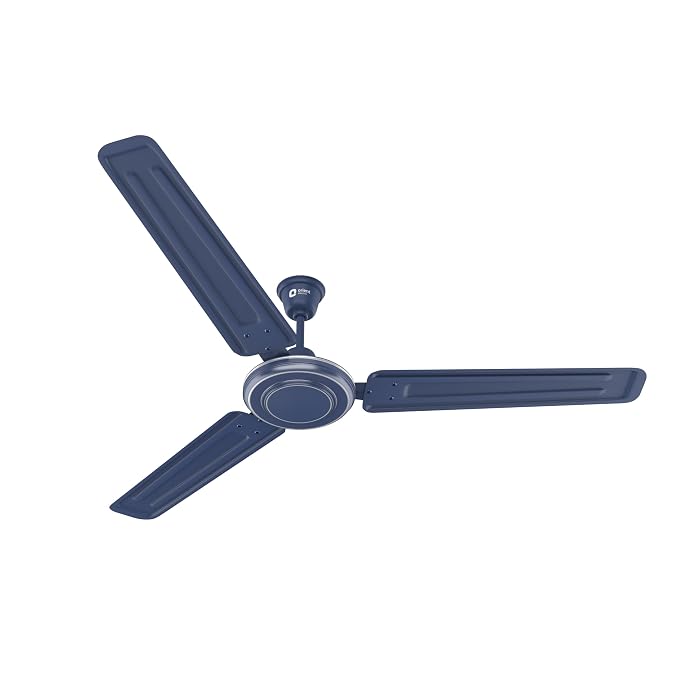
This is the fan most people picture when they say “ceiling fan” — a standard 1200mm sweep, galvanised rust-resistant blades, and a motor rated for double ball-bearing smoothness so it doesn’t start wobbling or ticking after a year of monsoons. It’s a BEE 1-star rated fan, which puts it firmly in the budget-efficiency bracket rather than the premium BLDC one.
What I like is that it doesn’t try to be clever — no remote, no app, just a fan that spins reliably and is easy for any local electrician to install without special wiring. If your priority is a dependable replacement for an ageing fan rather than a showcase piece, this is the sensible, unglamorous choice.
Best for: Anyone replacing a standard bedroom or living room ceiling fan without overthinking it.
- 👍 Galvanised blades resist rust in humid bathrooms-adjacent rooms
- 👍 Double ball-bearing motor stays smooth for years
- 👍 Any local electrician can install it without special wiring
- 👍 2-year warranty from an established Indian brand
- 👎 1-star rating means it isn’t the most power-efficient option here
- 👎 No remote or speed-regulator included in the box
- 👎 Basic looks — not a fan you’d pick for a statement room
atomberg Renesa 400mm Table Fan — the quiet, energy-saving option
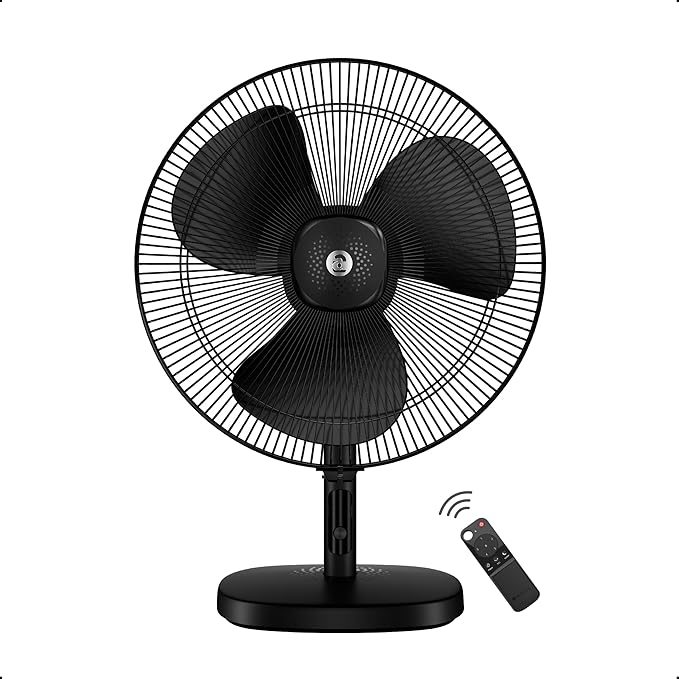
atomberg built its name on BLDC motors, and this table fan is where that tech actually shows. It’s rated to use around 35W at top speed — noticeably less than a regular table fan pulling 55-70W for the same airflow — and atomberg claims up to 35% savings versus an unrated fan, which tracks with what BLDC motors typically deliver.
The bigger everyday win is the noise floor: under 57dB is genuinely library-quiet compared to the whirr of a standard table fan, which matters a lot if it’s running next to you on a work-from-home desk for eight hours. The remote covers speed, oscillation, a boost mode and a sleep timer, and it also holds its RPM steady through voltage swings between 165V-285V — a real feature for areas with unstable supply, not a spec-sheet throwaway.
Best for: Home offices, study tables and bedrooms where noise and electricity bills both matter.
- 👍 BLDC motor genuinely uses less electricity than a regular table fan
- 👍 Noticeably quieter — comfortable next to a work desk all day
- 👍 Holds speed steady through voltage fluctuations, useful outside big cities
- 👍 Remote control with timer and sleep mode
- 👎 Costs more upfront than a basic table fan of the same size
- 👎 400mm sweep won’t cool a large room the way a ceiling fan does
- 👎 Being lightweight and portable, it’s less stable on very smooth or uneven floors
Bajaj Pygmy Go 178mm — the power-cut backup that lives on your desk
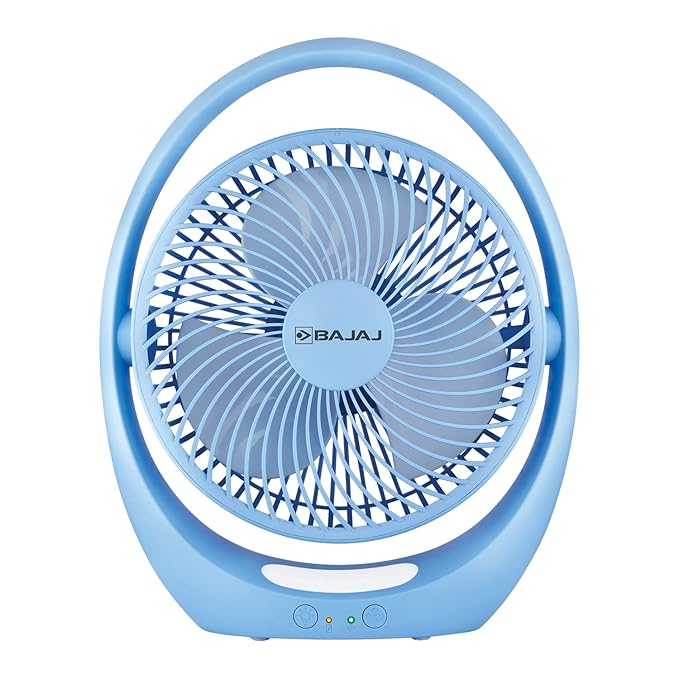
This isn’t trying to replace your ceiling fan — it’s the thing you switch on the moment the power goes and your main fan stops. A 2400mAh battery gives roughly 4 hours of backup, which comfortably covers a typical outage, and it runs at a genuinely brisk 2100 RPM on high while sipping only about 8W, so it doesn’t drain fast even on the strongest setting.
It also doubles as a small LED light source in the dark, which is a nice touch nobody asks for until the power’s actually out and they need both a fan and a torch at 11pm. USB charging means you can top it up from a power bank or laptop, not just a wall socket.
Best for: Areas with frequent power cuts, or anyone who wants backup airflow without running to buy an inverter.
- 👍 Roughly 4 hours of battery backup — enough for most outages
- 👍 USB charging works from a power bank, laptop or wall adapter
- 👍 Doubles as a dim LED light in the dark
- 👍 Compact enough to keep on a bedside table or work desk
- 👎 Airflow covers one person, not a whole room
- 👎 Battery capacity fades with age like any lithium pack — expect a couple of years of solid use
- 👎 Not a substitute for a proper ceiling fan on a hot night
Gesto Portable Mini Fan — the one that actually lives in a bag
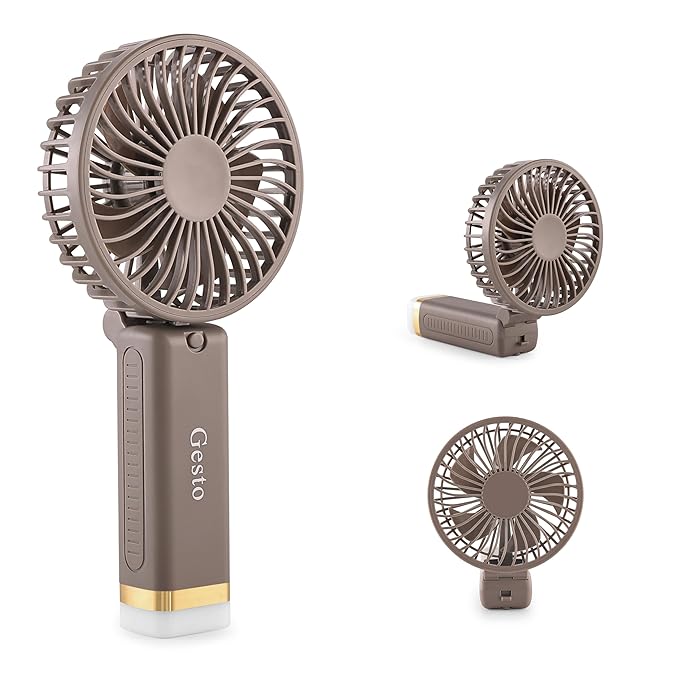
This is the category most “best fan” lists skip entirely, and it’s genuinely useful — a pocket-sized fan with a 1200mAh battery and three speeds, meant for the train platform, the kitchen while you’re cooking, or the desk drawer for a quick face-cool during a power cut. It’s USB-rechargeable from basically anything with a charging port.
Don’t expect room-cooling power from something this small — it’s a personal-comfort gadget, not appliance-grade cooling. But for what it is, three speed settings and a genuinely long-lasting charge for the size make it a sensible low-cost add-on rather than a main purchase.
Best for: Commutes, travel, kitchen work, or anyone who wants a personal fan smaller than their phone charger.
- 👍 Small enough to carry daily — bag, pocket or desk drawer
- 👍 3 speed settings for a device this size
- 👍 Charges from any USB source, including a power bank
- 👍 Useful in the kitchen, on commutes, or as an emergency backup
- 👎 Purely personal cooling — no use for an entire room
- 👎 Plastic build feels exactly as budget as the price suggests
- 👎 Battery life drops noticeably on the highest speed setting
Frequently Asked Questions
Which is better for saving electricity: a BLDC fan or a regular fan?
BLDC (Brushless DC) motors like the one in the atomberg Renesa use meaningfully less power than standard induction motors — often 30-50% less at the same airflow. They cost more upfront, but on a fan that runs for hours daily through an Indian summer, the electricity savings add up over a couple of years.
What does the BEE star rating on a ceiling fan actually mean?
It’s the Bureau of Energy Efficiency’s rating (1 to 5 stars) for how much power a fan uses for its airflow. A 5-star fan uses noticeably less electricity than a 1-star one at the same speed. It doesn’t affect how strong the breeze feels — it affects your electricity bill.
Do I need an electrician to install a ceiling fan?
Yes, for a proper ceiling fan like the Orient Electric Apex-FX — it needs to be wired to an existing ceiling point and balanced correctly, which isn’t a DIY job unless you’re simply swapping an identical old fan. Table and rechargeable fans need no installation at all.
Are rechargeable fans actually useful, or just a gimmick?
Genuinely useful if you get regular power cuts — a rechargeable fan like the Bajaj Pygmy Go gives a few hours of backup airflow without needing an inverter. They’re not meant to replace your main fan; think of them as insurance for the 30-60 minutes the power’s out.
Which fan is quietest for a bedroom?
Of the options here, the atomberg Renesa table fan is the clear winner on noise — its BLDC motor runs well below the noise level of a standard induction-motor fan at the same speed, which matters if it’s running near your bed overnight.
Does humidity or hard water damage ceiling fans in India?
Over years, yes — moisture and hard water in the air can corrode cheaply painted blades and motor housings, especially in coastal or high-humidity regions. Rust-resistant galvanised blades, like on the Orient Electric fan here, hold up noticeably better long-term than basic painted ones.
The bottom line
If you’re buying one fan for a room, the Orient Electric Apex-FX is the sensible, no-drama ceiling fan pick. If electricity bills and noise bother you more than upfront cost, spend the extra on the atomberg Renesa — the BLDC motor pays for itself over time. And if power cuts are a regular part of your life, a rechargeable backup like the Bajaj Pygmy Go or the pocket-sized Gesto mini fan is a genuinely useful, affordable add-on rather than a luxury.
As an Amazon Associate we earn from qualifying purchases — at no extra cost to you. We don’t print prices or ratings here because they change daily; tap through to Amazon for the current price and latest reviews.